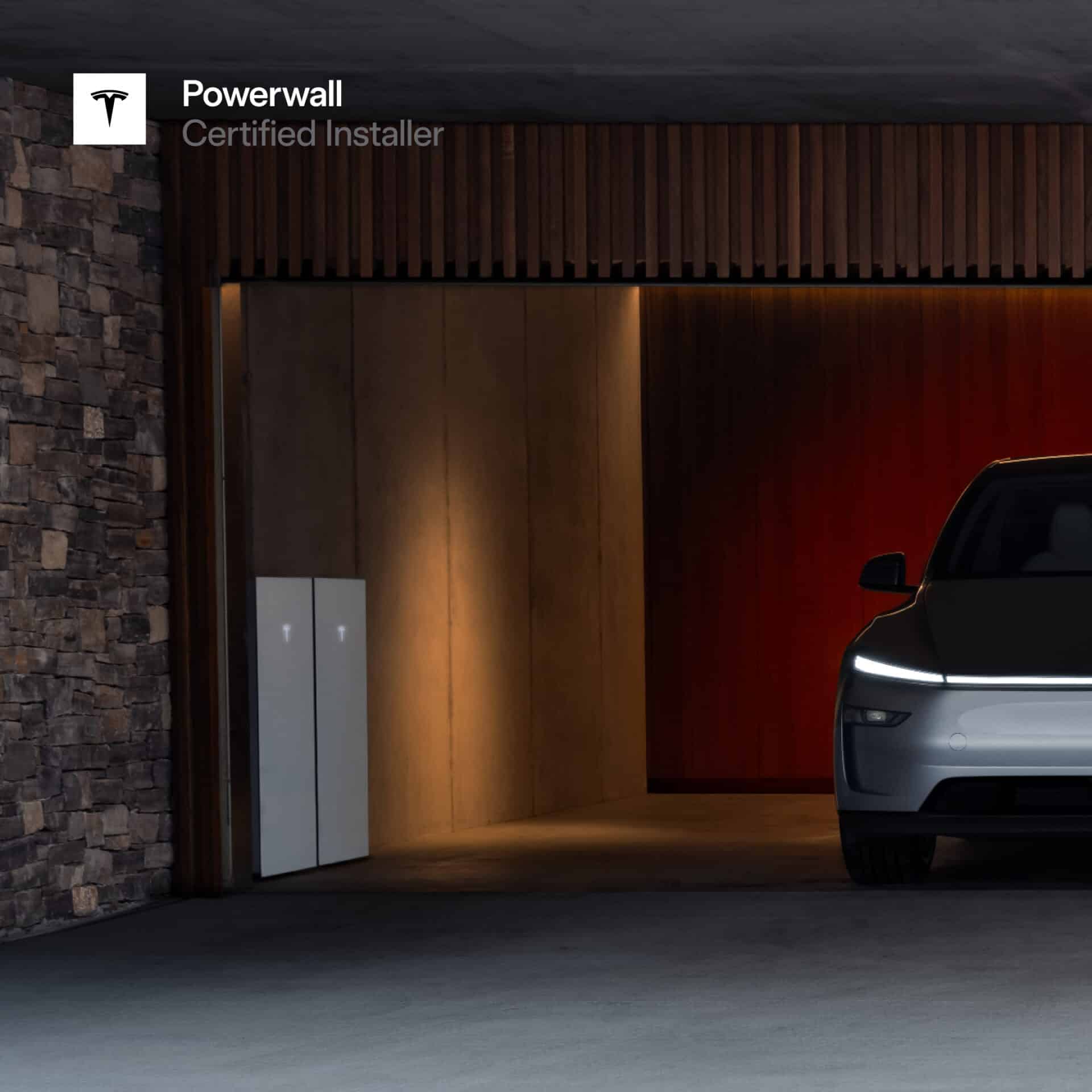
IMS Heat Pumps is proud to announce that we are now a Tesla Premium Certified Installer, recognising our expertise in the design, installation and commissioning of Tesla Powerwall battery storage systems.
This certification is awarded to a select group of installers who consistently meet Tesla’s high standards for technical knowledge, installation quality and customer experience.
It reflects our proven track record delivering reliable, high-quality home battery installations (and solar panel installations) for homeowners looking to take greater control of their energy use.
What does Tesla Premium Installer status mean?
Becoming a Tesla Premium Installer means our customers can be confident that:
- Tesla Powerwall systems are installed to Tesla’s approved standards
- System design, installation and commissioning are carried out by trained specialists
- Installations are backed by professional aftercare and long-term system support
Choosing a Tesla Premium Installer provides added peace of mind that your battery storage system will perform as intended and integrate seamlessly with your solar PV system and household energy use.
Current Tesla Powerwall rebate
To celebrate one million Powerwall units installed worldwide, Tesla is currently offering a rebate of up to £750 on Powerwall 3 and Powerwall 3 Expansion systems, available through Tesla Premium Installers such as IMS Heat Pumps.
The rebate applies to eligible systems sold between 1 December 2025 and 31 March 2026, with installations completed by 31 May 2026.* Our team will explain how the rebate works, confirm eligibility and ensure all relevant requirements are met as part of your system design and quotation.
Why Tesla Powerwall 3?
Tesla Powerwall 3 is designed to work seamlessly with modern homes and solar PV systems. With higher power output and improved integration, it allows homeowners to store more of their own energy and use it when it matters most.
Powerwall 3 can store electricity generated by solar panels or drawn from the grid, helping reduce reliance on imported energy and improving resilience during power cuts. The system is fully managed through Tesla’s app, giving clear visibility of energy generation, usage and storage in real time.
Powerwall works best as part of a complete energy system
While Powerwall can be installed on its own, it delivers the greatest benefit when paired with solar PV. Storing excess solar generation allows more of your own electricity to be used in the home, rather than exporting it back to the grid.
At IMS Heat Pumps, we design solar and battery systems together, ensuring panel sizes, battery capacity and household demand are correctly matched. This whole-system approach helps maximise performance and long-term value.
Is Powerwall right for your home?
Battery storage is particularly well suited to homes with solar PV, time-of-use electricity tariffs, or higher evening energy demand. During an initial consultation, we assess your usage patterns, available installation space and future plans, such as electric vehicles or low-carbon heating, to ensure the system is a good fit.
Our team will always provide clear advice on whether a battery system is suitable and correctly sized for your property.
A natural step for IMS Heat Pumps
We have been delivering renewable and low-carbon heating solutions since 1997. Achieving Tesla Premium Installer status builds on our existing accreditations, including MCS certification, TrustMark approval and membership of the Which? Trusted Trader scheme.
Our approach focuses on whole-system design rather than one-size-fits-all solutions, ensuring that solar panels, battery storage and low-carbon heating systems work efficiently together for each home.
Considering solar and battery storage?
If you’re thinking about installing solar PV or battery storage, our experienced team can help you understand your options and design a system tailored to your energy needs. Get in touch to request a quote.
*Rebate availability, eligibility criteria and terms are set by Tesla and may be subject to change.
Get in touch
Find out more about our services or request a quote.
Enquire Online
Frequently Asked Questions
-
Solar panels contain photovoltaic (PV) cells. These are made from semiconductor materials that convert sunlight into direct current (DC) electricity.
An inverter then converts this to alternating current (AC) for use in your home.
Panels still generate electricity on cloudy days, just at a reduced output.
-
Most homes are suitable.
South-facing roofs at a 30–40° pitch give the best output. But east- or west-facing roofs work well, too.
We carry out a free site survey to assess your roof’s suitability and design the right system for your home.
-
In most cases, no.
Solar panels are classed as permitted development on most residential properties in the UK. Exceptions include:
- Listed buildings
- Properties in conservation areas
- Some flats.
We’ll advise on whether you need planning permission for your solar during your free site survey.
-
A typical 3–4kW solar system generates around 2,500–3,500 kWh per year in the UK.
However, the final figure varies depending on your location, roof orientation, and any shading.
-
Any unused electricity can either:
- Be stored in a battery to use later
- Be exported to the grid under the Smart Export Guarantee (SEG). Your supplier pays you for what you send back
-
Not necessarily, but it makes a significant difference.
A battery lets you store surplus electricity generated during the day to use in the evening, during a power cut, or when the sun isn’t shining.
It maximises your energy independence and reduces what you draw from the grid.
-
No.
You can install a battery without solar panels — it can be charged from the grid during off-peak hours when electricity is cheaper.
That said, pairing a battery with solar panels significantly increases your savings and energy independence.
And. adding a heat panel can further maximise your savings (Read: ‘The Power of the Golden Trio: Heat Pups, Solar Panels, and Battery Storage’.)
-
Yes.
Even if you’re not home, you can earn money by exporting unused electricity to the grid through the Smart Export Guarantee (SEG).
Adding a battery means you can store daytime generation and use it in the evenings, further maximising the value of your system.
-
A typical solar PV system costs between £5,000 and £8,000, depending on size and specification.
Adding battery storage typically costs an additional £3,000–£6,000.
Get in touch for a free, no-obligation quote tailored to your home.
-
Yes. There are no direct grants for most homeowners. But there are sources for funding solar that you can benefit from:
- Zero VAT on solar panel and battery installation (until March 2027)
- Smart Export Guarantee (SEG) payments from your supplier for exporting electricity
- Interest-free loans are also available in Scotland through Home Energy Scotland.
-
Yes.
There are a range of green finance products available to help spread the cost of solar installation. These include green mortgages and specialist renewable energy loans.
We can point you in the right direction.
-
Yes. Solar panels pair excellently with heat pumps and electric vehicle (EV) chargers.
By combining these technologies, you can significantly reduce your energy bills and carbon footprint.
Adding a battery lets you store any surplus solar energy to use when you need it most.
-
Not without a battery. For safety reasons, standard grid-connected solar systems automatically shut down during a power cut to protect engineers working on the lines.
With a battery and the right inverter configuration, you can keep essential appliances running during an outage.
-
Solar panels are designed to last 25 years or more. Most coming with a 25-year performance warranty.
Inverters typically need replacing after 10–15 years, and battery storage systems after 10+ years.
-
Very little. Solar panels are largely self-cleaning, though an occasional rinse can help if they become dirty.
We recommend a periodic system check to ensure everything is running efficiently. We offer service packages to take care of this for you.
-
Potentially, yes. Solar panels are an increasingly attractive feature for homebuyers.
Properties with solar panels are viewed as more energy-efficient and future-proofed. This can increase both saleability and value — particularly as energy costs remain high.
-
The right system size depends on your household’s electricity usage and available roof space.
Most 3–4 bedroom homes suit a 3.5–4kW system.
We carry out a full assessment of your home and energy use to recommend the ideal system size.
-
The Smart Export Guarantee (SEG) is a government scheme that requires licensed energy suppliers to pay for surplus electricity export to the grid from solar panels.
Rates vary between suppliers, so it’s worth shopping around for the best deal.