

There are two main types of heat pumps: Air source heat pumps and ground source heat pumps.
(There are also water source heat pumps, but these are relatively rare.)
Both heat pumps work along the same principles but in different ways.
This makes them suitable for different situations.
And it gives each unique advantages and disadvantages.
Read on to find out more.
Air source heat pumps: Brief overview
Air source heat pumps (ASHPs) extracts heat from the outside airand use it to power heating and hot water.
They use fans to draw it across a large metal heat exchanger filled with refrigerant. Heat from the air moves into this refrigerant.
Ground source heat pumps: Brief overview
Ground source heat pumps (often mistakenly referred to as “geothermal heating”) extract heat from the soil or rock beneath the earth’s surface to power heating and hot water.
A network of pipes (a ground loop) are buried in shallow trenches or vertical boreholes (depending on space).
Heat gathered by these pipes is then brought into heat pump in much the same way as air is in air course heat pumps.
Other types of heat pumps
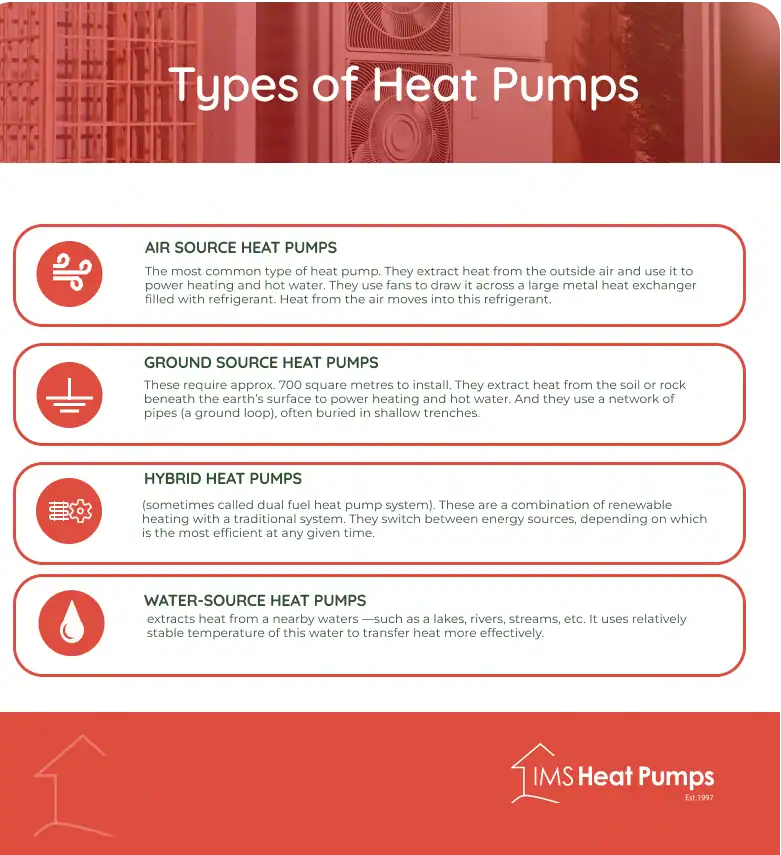
Hybrid heat pumps are a another type of heat pump option. They using a combination of renewables and fossil fuels.
And water source heat pumps are efficient but rare heat pumps that require access to a large pond, a river or a lake.
Comparing ground and air source heat pumps
1. Space requirements
Air source heat pumps’ external units can fit on the outside of most properties. So, they take up less space than ground source heat pump systems.
However, you still need to find the right amount of outer wall room to host an air source heat pump’s external unit.
This can be difficult for properties in urban areas, and for properties with irregular-shaped external walls.
Meanwhile, the space requirements for ground source heat pumps are about 700 – 1,200 square meters if using trenches.
If vertical boreholes are used, there simply needs to be enough space for drilling machinery to gain access. So about, 3 meters.
“A good starting point is to assess whether there is adequate land for a horizontal GSHP. If space is insufficient, an air source heat pump may be the next best option.
– Luke Begley, Installation Manager, IMS Heat Pumps
Vertical GSHPs are considered when higher efficiency is needed and space is limited, despite their higher installation costs.”
2. Purchase and installation costs
Air source heat pumps are also typically cheaper to buy and install than ground ones. This is because there is no need for
Ground source installation costs are usually between £12,000 to £15,500.
(Financial assistance is available in the form of the Boiler Upgrade Scheme in England and Wales – and the Home Energy Scotland Loan in Scotland.)
Horizontal GSHP installations are generally less expensive and complex compared to vertical installations.
“With regards to the economics, at the outset we usually prefer a horizontal ground source heat pump system as the most desirable renewable heating solution.
– Emma Bohan, Managing Director at IMS Heat Pumps
This technology is the most cost-effective in the medium-to-long-term, although of course it is not always suitable for every property and other options do come into play if this solution doesn’t fit the project.”
Additional support
Besides the grants available for heat pumps, there are other ways to get financial support for installing a heat pump.
For instance:
- Barclays offer a £2,000 reward for mortgage customers who install low carbon heating
- Lloyds provides a £1,000 reward for qualifying mortgage customers who get a heat pump.
In some regions of the UK, there are government-funded schemes to help low-income homeowners improve the energy efficiency of their homes.
For example, the ECO4 scheme offers funding for energy efficiency improvements for eligible households.
Check with your local authority to see if there are any grants or schemes running in your area and if you may be eligible.
Read our Guide to Funding for Heat Pumps for more detailed information.
3. Noise
Heat pumps are not noisy (it is a common heat pump myth that they are!). Neither type will not cause disturbance if installed correctly and maintained properly.
However, there is a noise factor to take into account when comparing the two heat pump types.
The external unit of an air-source heat pump will whirr somewhat, and the compressor will make a humming sound.
(Vaillant have created an excellent simulator for you to gauge the level of air source heat pump noise. The site is German so need to translate!)
Ground source heat pumps, which are underground, are quieter. But we are only talking by a range of about 10 decibels (dB).
4. Visual Appeal
By and large, ground source heat pumps are more subtle than air source ones. This is due to the fact that most of the system is buried.
Air source heat pumps are mostly above the ground, which can be obvious to the eye.
If your external unit is on a highly visible part of your property, you can use an ASHP container case. It softens aesthetic impact by matching it to your building’s exterior.
5. Operational Costs
Heat pumps operate using a small amount of electricity. This may be renewables-sourced electricity, or electricity direct from the grid.
Air source heat pumps’ running costs are typically higher than ground source heat pumps’ because they consume more electricity.
6. Lifespan
An air source heat pump has more components that are exposed to the elements than a ground source heat pump.
This means that weathering, plus general wear and tear is more significant.
This won’t be a problem if you commit to annual servicing (also recommended with ground source systems), but it does ultimately mean the lifespan of a an ASHP is shorter than that of a GSHP.
A well-maintained air source heat pump is likely to last around 15 years, whereas a ground source heat pump is likely to last around 20 years.
Summary
Most often, a horizontal ground source heat pump presents the best balance of efficiency, cost, and return on investment within the shortest time frame. We will never shoehorn a horizontal ground loop array where it doesn’t belong, but it is usually a good starting point when evaluating your options for switching to renewable heat.
– Arran Donald, Installation Manager, IMS Heat Pumps
Both types of heat pump are efficient, affordable, and environmentally friendly.
Air source heat pumps are more common, largely because they require less space and are cheaper to install.
However, as a general rule of thumb, ground source heat pumps are more efficient in terms of the units of energy generated. This is especially the case during winter, when the system has to work harder.
That said, the difference isn’t always significant and depends on the property’s heating distribution system (underfloor heating or radiator systems).
And a ground source heat pump is more expensive to buy and install at the outset. (Though horizontal ground source heat pumps are cheaper than vertical ground source heat pumps.)
Each property is unique. So, you need a qualified MCS-certified installer to supply the most suitable system for your individual needs.
If you’d like to know more about ground source heat pump installation or air source heat pump installation for your home or commercial building, contact IMS Heat Pumps today.